
Picture the scene. You pull up outside your 1950s semi in Leicester, the same house you have lived in for years, and for the hundredth time your eye goes straight to the pebbledash. It is patchy, stained, and starting to crack at the corners. The neighbour three doors down had theirs removed last spring. Their house sold within two weeks of going on the market, and for more than the asking price. Yours is still sitting there looking like a wet weekend in 1962.
If that sounds familiar, you are in good company. Pebbledash removal and rendering is one of the most searched-for home improvement topics across Leicester, Birmingham, and the wider Midlands, and the reasons why are not hard to understand. The finish was slapped onto hundreds of thousands of post-war properties as a cheap, fast solution and it has been quietly deteriorating ever since.
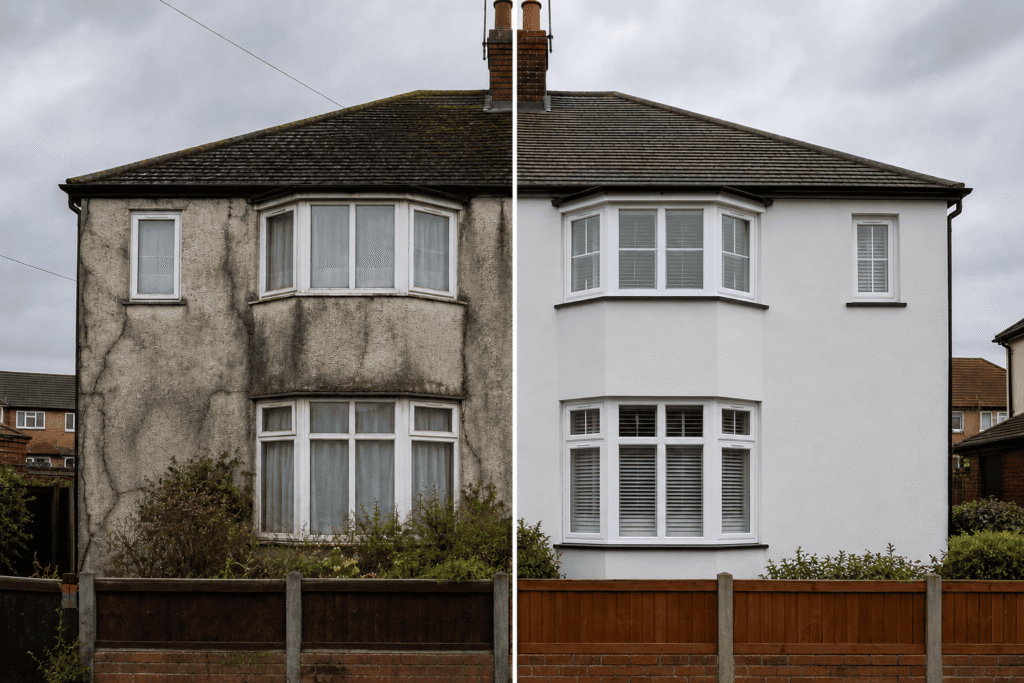
The good news is that the process is well-established, the costs in 2026 are clearly defined, and the results, when done properly by experienced installers, are transformative. This guide covers everything you need to know before you pick up the phone.
What Is Pebbledash and Why Do So Many Homeowners Want It Gone?
Pebbledash is not quite the same thing as standard render. The process involves throwing small stone fragments onto wet mortar and pressing them in, creating that distinctive rough, uneven texture that became the go-to finish for cheaper UK housing from the 1930s through to the post-war years. It is often confused with rough-cast rendering, which mixes larger stones directly into the cement and sand before application, producing a slightly smoother result.
For a few decades, pebbledash did its job. It was weatherproof, reasonably durable, and required very little skill to apply at scale. The problem is that most of it was applied between 60 and 90 years ago. Pebbledash typically lasts 20 to 40 years before it starts to deteriorate, which means the vast majority of properties across the Midlands are well past their sell-by date.
When it goes, it really goes. Cracks appear and allow water in. Frost gets into those gaps over winter and forces them wider. Algae and moss take hold, staining the surface. Damp starts appearing on internal walls. And all of this is visible from the street, which is exactly why buyers either negotiate hard or walk away entirely.
There is another reason homeowners want pebbledash removed that often gets overlooked: it was frequently applied to period properties during the post-war years specifically to cover up damage. If your home is an Edwardian or inter-war terrace, there is a decent chance the original brickwork underneath is in better shape than the pebbledash on top of it, and that the brick finish would actually add far more character and kerb appeal than anything covering it.
For properties where the underlying brickwork is not worth exposing, or where the surface damage has gone too far to make brick restoration practical, pebble dash removal and re-rendering is the most effective and long-lasting solution available.
Pebble Dash Removal and Rendering Costs in 2026
Cost is almost always the first question homeowners ask, and rightly so. The honest answer is that it depends on your property size, your location, the condition of the underlying substrate, and what you choose to do with the exterior once the pebbledash is off.
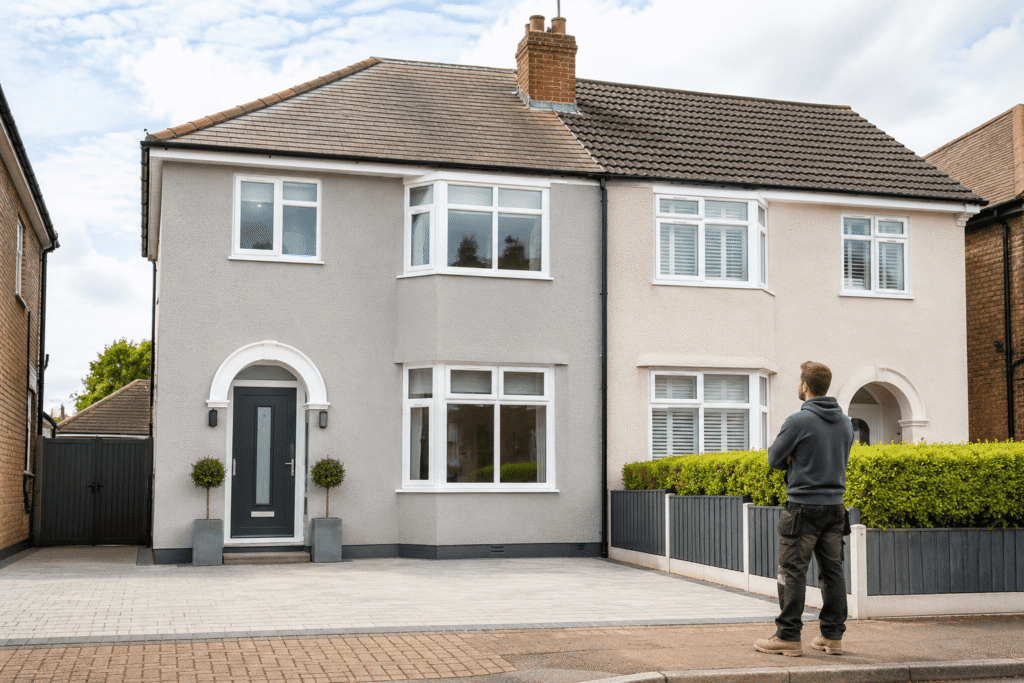
Here is what homeowners across Leicester, Leicestershire, Birmingham, and the Midlands should budget for in 2026.
| Property Type | Estimated Removal & Re-Render Cost | Typical Labour Cost | Key Notes |
| 2-Bed Terrace | £2,000 to £4,500 | £15 to £40 per m² | Simpler access and lower scaffolding costs. |
| 3-Bed Semi-Detached | £3,800 to £5,200 | £150 to £250 per day | The most common property type across the Midlands. |
| 4-Bed Detached | £6,300 to £7,800 | £150 to £250 per day | Larger wall area and more preparation time increase costs. |
| Bungalow | £2,100 to £3,000 | £15 to £40 per m² | Easier access and reduced scaffolding requirements. |
| Scaffolding (Additional) | £300 to £900 | Varies by property height | Usually required for most two-storey homes. |
| Skip Hire (Additional) | £150 to £300 | Fixed cost | Required for disposing of old render and site debris. |
These figures do not include painting or any remedial brick repairs that may be needed once the existing render is removed. That matters, because what is underneath is not always predictable until the work begins.
What actually moves the final number? The size and shape of the property is the obvious one, but substrate condition plays a bigger role than most people expect. If the brickwork beneath has been compromised, damaged bricks need replacing and mortar joints need repointing before anything new can go on. The type of render you choose for the new finish also affects cost. Cement render sits at the lower end, while monocouche and silicone systems cost more upfront but last considerably longer and come with much lower maintenance requirements over the years that follow.
The other question worth asking is whether the cost is justified. Professional rendering adds 2% to 10% to property value depending on quality and location. Modern silicone and monocouche systems last 15 to 30 years with minimal maintenance. When combined with external wall insulation, the improvement in thermal performance typically delivers energy bill savings that pay back the investment within 5 to 8 years. Looked at across a 10 or 15-year horizon, the cost of not doing it is usually higher than the cost of getting it done properly.
For a detailed breakdown of house rendering costs, the Advanced Wall Protection cost guide covers the full picture.
The Three Options for Dealing with Pebbledash
Not every pebbledash situation calls for the same response. There are three realistic options, and the right one depends on the condition of your walls and what you want the finished result to look like.
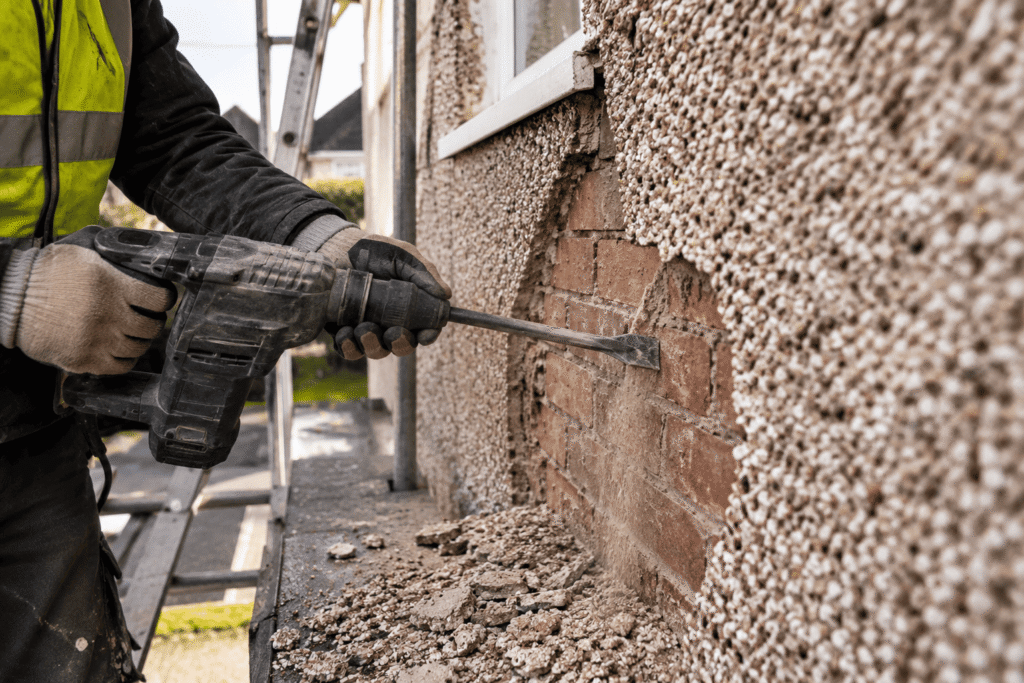
Option One: Remove and Expose the Original Brickwork
This approach makes sense for period properties where the original brickwork is architecturally attractive and likely to be in reasonable condition beneath the render. If you own an Edwardian or 1930s home in a desirable part of Leicestershire or Birmingham, exposed brick can add genuine character and be a real selling point.
The caveat is that this process is extremely labour-intensive and the outcome is not guaranteed. At best, the brickwork will need cleaning and repointing once the render is off. At worst, removing the pebbledash reveals substantial damage that was either hidden by the original application or caused during the removal process itself. Steam or acid washing is often needed to bring the brick back to a presentable state, and that adds cost on top of the removal.
It is worth having an experienced installer assess the wall condition before committing to this route.
Option Two: Repair and Paint
This is the cheapest short-term option. If the existing pebbledash is damaged in patches but broadly intact, those areas can be repaired and the whole surface spray-painted to create a more even appearance.
The problem is that it does not look seamless. Repaired patches rarely blend perfectly with aged pebbledash, and even with spray painting the joins tend to show over time. More importantly, it does not address any underlying damp, mould, or structural issues in the wall. It is a cosmetic fix that buys time, not a long-term solution.
Option Three: Remove and Re-Render
This is the recommended approach for the majority of properties. It strips the textured surface cleanly, allows for proper inspection and treatment of the underlying substrate, and results in a fresh exterior that looks modern, protects against damp and mould, and performs significantly better from an energy efficiency perspective.
The new render can be applied in whatever system suits the property best, smooth silicone, textured monocouche, or a breathable lime finish for older buildings. A breathable paint or waterproof sealant is applied as a final layer. The result is a clean, durable finish that genuinely transforms kerb appeal and stands up to UK weather for decades rather than years.
This is the approach taken by Advanced Wall Protection Ltd across Leicester, Leicestershire, Birmingham, and the wider Midlands, and it is the one that delivers consistent, long-term results.
The Pebble Dash Removal and Rendering Process: What Actually Happens on Site
Understanding the process helps homeowners know what to expect, what questions to ask before work starts, and how to recognise when a job is being done properly.
Step One: Assessment and Free Survey
Everything starts with a thorough assessment. An experienced installer will tap-test every wall to identify hollow or blown sections, take damp readings, photograph all problem areas, and assess the brick condition to build a complete picture of the property. If asbestos is discovered during the survey, which can happen in certain post-war properties, the correct HSE protocols are followed before any removal work begins.
A free no-obligation survey from Advanced Wall Protection Ltd is always the sensible starting point. It takes the guesswork out of costs and gives you a clear plan before a single penny is committed.
Step Two: Scaffolding and Site Protection
Scaffolding is erected to provide safe working access for two-storey properties, which accounts for most of the housing stock across Leicester and Birmingham. Windows, UPVC doors, and garden areas are protected from debris throughout. If the UPVC frames show signs of wear or seal failure, this is a good point to flag that up, because a fresh render job next to damaged frames is a missed opportunity.
Step Three: Pebbledash Removal
The existing render is removed using SDS drills, chisels, and heavy-duty scrapers. This is the most physically demanding part of the process. It needs to be done carefully to avoid damaging the brickwork beneath, and it cannot be rushed. Any blown sections of render already hanging loose from the wall are fully stripped before any new work begins.
Step Four: Substrate Cleaning and Repair
Once the walls are clear, the brickwork is cleaned, typically using steam or acid washing depending on the level of staining and contamination. Damaged or broken bricks are replaced, weak mortar joints are repointed, and any damp-affected areas are treated before the new render goes on. Mould prevention treatment is applied where needed. This preparation stage is what determines how well the new render performs over the years ahead.
If you have had recurring damp issues inside the property, this stage addresses the root cause at source. The Advanced Wall Protection guide on rendering and damp explains the relationship between exterior render and internal damp in detail.
Step Five: New Render Application
The new render system is applied to the prepared substrate. For standard re-renders, this involves one or two coats of sand-and-cement or silicone render. Where external wall insulation is being incorporated, insulation boards are fixed to the wall first, followed by a base coat and reinforcing mesh, and then the chosen render top coat. This is the step that makes the biggest difference to thermal performance and energy efficiency.
Step Six: Finishing and Protection
A breathable paint or weatherproof sealant is applied as the final layer, sealing the surface against moisture while allowing the wall to breathe. Any colour matching needed for adjacent areas is done at this stage. The site is cleared, scaffolding comes down, the skip is removed, and a final inspection is carried out before sign-off.
The Full Exterior Protection Package: What to Think About Alongside the Render
Pebble dash removal and rendering transforms the visible exterior of a house. But the most value comes from treating the whole exterior as a connected system rather than a series of separate jobs.
External Wall Coatings and Insulation
When rendering is combined with an external wall coating and insulation system, the thermal performance of the home changes significantly. Heat that was escaping through bare or poorly insulated walls stays inside, boilers work less hard, and heating bills drop in a way that homeowners across Leicestershire and Birmingham notice almost immediately. For older properties with solid walls, this combination is one of the most cost-effective energy efficiency investments available.
Roof Coatings
A freshly rendered exterior draws the eye upward, and what buyers and valuers see next is the roof. Damaged, porous, or moss-covered roof surfaces allow water ingress that works its way into internal walls regardless of how good the render below is. A professional roof coating extends roof life, protects against frost damage and moss growth, and completes the external protection package. Addressing render and roof together is efficient, cost-effective, and gives the whole property a coherent, well-maintained appearance.
Plastering and Internal Follow-On Work
If damp has been penetrating the walls for some time before the pebbledash removal, the internal plasterwork may also need attention. The correct sequence is always exterior first. Fix the source of the moisture, then address what it has done inside. Attempting to replaster internally while the exterior is still allowing water in is money wasted.
UPVC Doors and Windows
A clean, modern rendered exterior makes tired or damaged UPVC frames stand out immediately. Seals around door and window frames should be inspected and replaced as part of any full exterior project. A consistent, well-maintained finish across the entire frontage signals to any buyer or valuer that this is a property that has been looked after properly. Nothing undermines the impact of a fresh render job quite like a cracked door frame beside it.
Guarantees and What They Actually Mean
A long-term written workmanship guarantee from experienced installers is not a nice to have. It is the single most important document that comes out of any rendering project. Modern silicone render systems carry manufacturer warranties of up to 25 years. A written workmanship guarantee from the installer covers the application itself. Together, they give homeowners documented, transferable confidence in the work, and that confidence has real value in any sale negotiation.
Advanced Wall Protection Ltd provides written guarantees on all projects across Leicester, Leicestershire, Birmingham, and the Midlands, backed by manufacturer-approved installer status.
For an insight into how a clean rendered finish is maintained over time, the Advanced Wall Protection rendering cleaning guide is worth reading alongside this article.
Why Professional Application Is the Only Sensible Option
It is possible to attempt pebbledash removal as a DIY project. It is also possible to attempt your own dental work, but most people reasonably conclude that the risk is not worth it.
Rendering is a skilled trade. The results depend entirely on the quality of the substrate preparation, the correct choice of render system for the specific property, and the consistency and precision of the application. A poorly prepared substrate leads to cracking and render failure within a few years. The wrong render system on the wrong wall can trap moisture and make damp worse rather than better. A visibly uneven finish actively reduces property value rather than adding to it.
Beyond the technical skill involved, professional application from manufacturer-approved installers keeps product warranties intact. That matters because a warranty on materials applied by an unapproved contractor may not be worth the paper it is printed on.
Advanced Wall Protection Ltd brings specialist knowledge built across years of local project delivery to homeowners across Leicester, Leicestershire, Birmingham, and the wider Midlands. No subcontracting. Every project is delivered by an in-house, trained, employed team.
The Bottom Line
Pebble dash removal and rendering in 2026 is a practical, high-return investment for the vast majority of Midlands homeowners dealing with a deteriorating or dated exterior. It protects against damp and mould, reduces heat loss, lowers heating bills, improves EPC ratings, modernises kerb appeal, and adds measurable, documented value to a property.
The cost is manageable and clearly defined. The process is well-established. And the long-term financial case is straightforward: the cost of doing it properly now is almost always lower than the cost of structural repairs, rising insurance premiums, and reduced sale prices further down the line.
If your property could benefit from a professional assessment, Advanced Wall Protection Ltd offers a free, no-obligation survey for homeowners across Leicester, Leicestershire, Birmingham, and the Midlands. Get in touch today and find out exactly what your property needs, what it will cost, and what it will look like when the job is done.
Frequently Asked Questions
- How much does pebble dash removal and rendering cost in 2026?
Costs range from £2,100 to £7,800 depending on property size and location. A typical 3-bed semi-detached in Leicester or Birmingham averages £3,800 to £5,200. Labour runs at £150 to £250 per day or £15 to £40 per m². Scaffolding adds £300 to £900 and skip hire adds £150 to £300 on top of that. These figures exclude painting and any remedial brick repairs uncovered during removal. A free survey from Advanced Wall Protection Ltd provides an accurate, property-specific quote with no obligation.
- Is it better to render over pebbledash or remove it completely?
Rendering directly over pebbledash is technically possible if the existing surface is completely sound, but it is not generally recommended. Adding another render layer increases the load on the wall and risks trapping moisture between the old and new surfaces. Removing the pebbledash first allows for a full inspection of the substrate, proper damp treatment, and a render system that bonds correctly and lasts significantly longer.
- How long does pebble dash removal and re-rendering take?
Most standard residential properties across the Midlands take between 7 and 14 days from start to finish, covering removal, substrate preparation, render application, and final finishing. Larger or more complex properties with significant brick repairs may take longer. Advanced Wall Protection Ltd provides a clear project timeline as part of the free survey process, so homeowners know exactly what to expect before work begins.
- Will removing pebbledash expose damage to the brickwork underneath?
It can, and on many post-war properties across Leicester and Birmingham it does. Pebbledash was often applied specifically to cover deteriorating brickwork, so finding damaged bricks, failed mortar joints, or damp-affected areas once the render is off is not unusual. This is exactly why a proper assessment before work starts is essential. Any damage uncovered during the process is repaired before new render is applied, which actually prevents far more costly structural problems further down the line.
- Does pebble dash removal and re-rendering add value to a house?
Yes. Professional rendering can add 2% to 10% to a property’s market value depending on quality and location. Beyond the uplift in sale price, removing failing pebbledash eliminates the damp risk, improves energy efficiency when combined with external wall insulation, lowers heating bills, and modernises the exterior in a way that makes the property more attractive and competitive to buyers across the Midlands. Buyers who might have negotiated down, or walked away, become buyers who make confident offers.